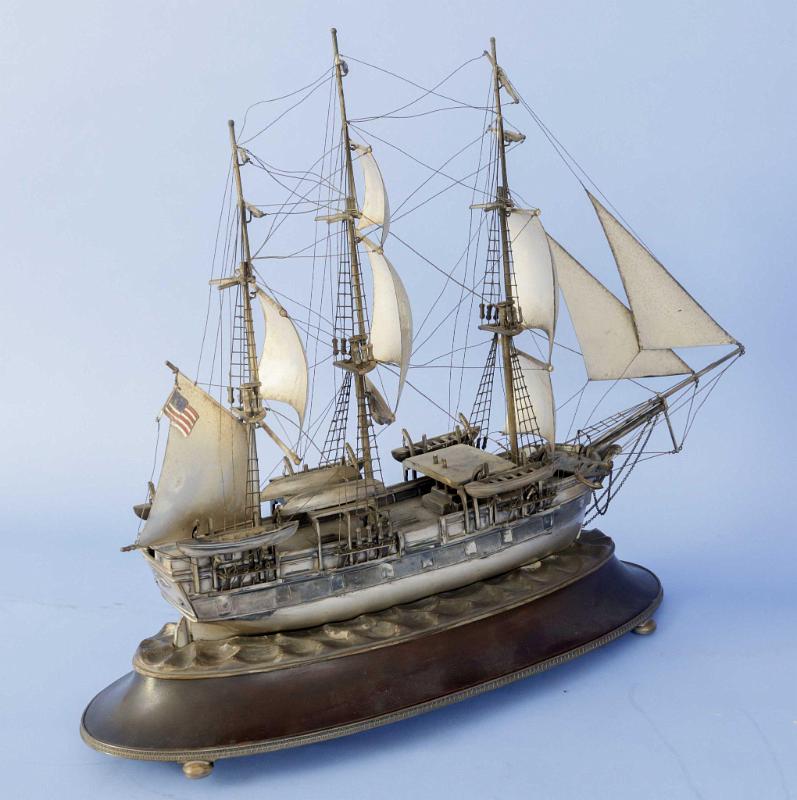
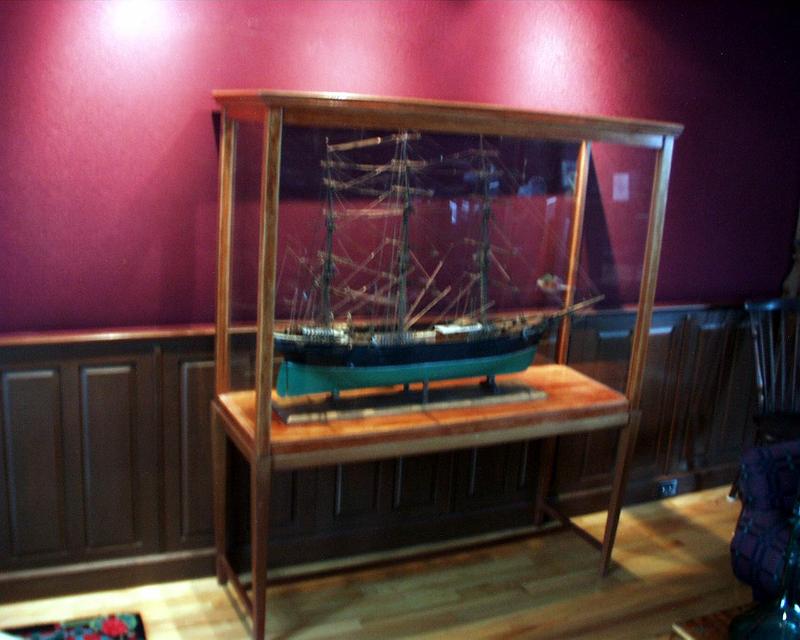
Exceptional Plank on Frame Model of the Whale Ship "Charles W. Morgan" by the Master Builder Peter Ness.
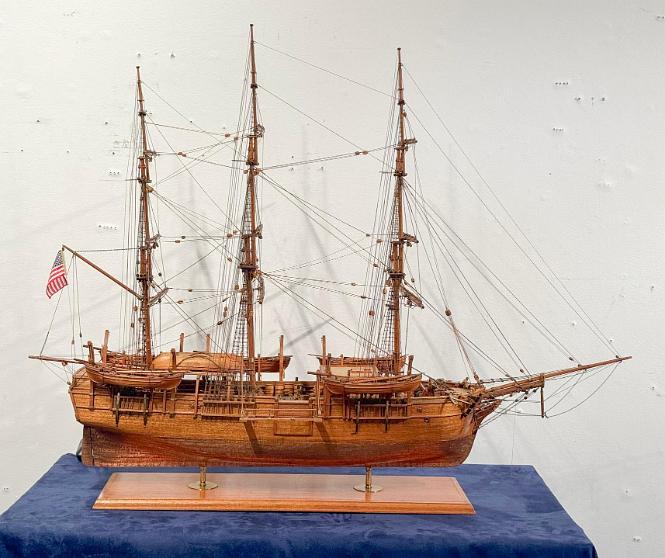
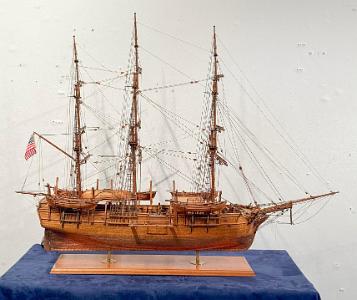
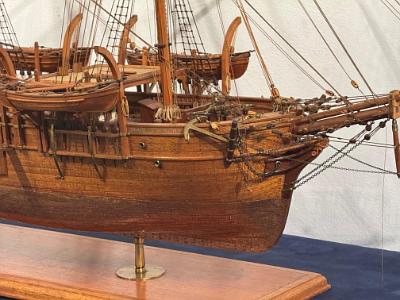
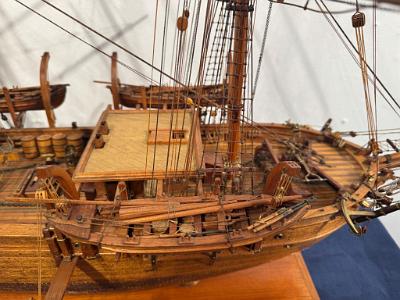
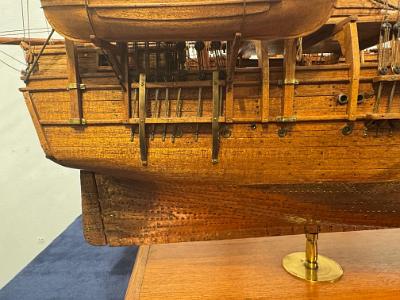
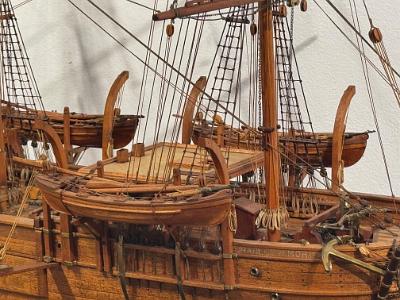
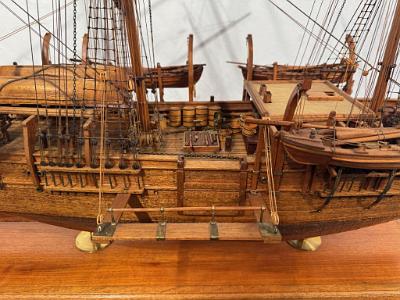
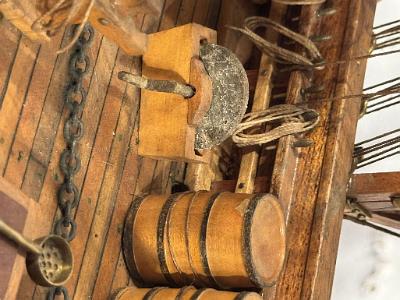
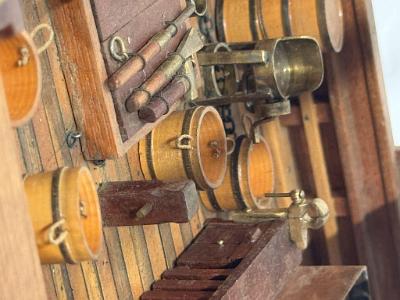
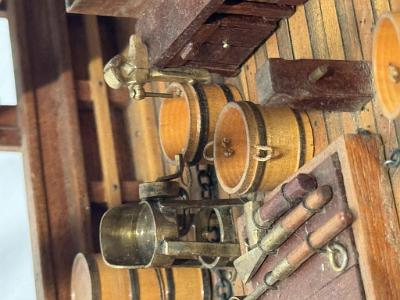
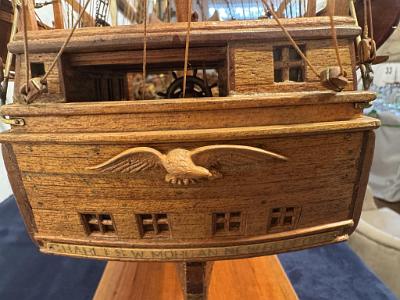
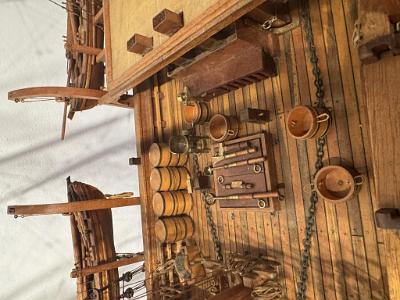
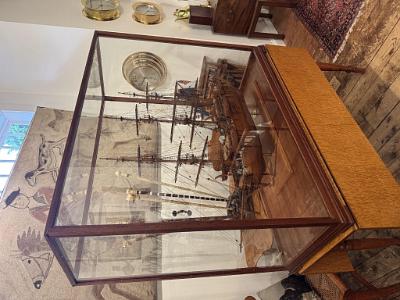
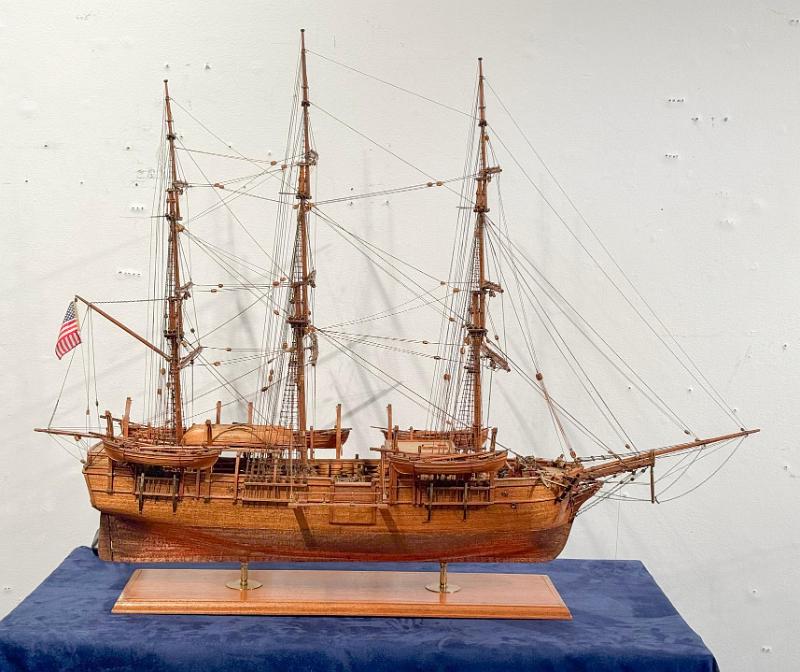
InformationPlank on frame “scratch built” mahogany ship model of an American whaleship titled on the stern board “Charles W. Morgan” by the renowned Boston ship model builder Peter Ness circa 1935. The materials and the style of construction are consistent with the other know Peter Ness models we have examined over the years.The hull has plank on frame construction. Each plank is attached to the ribs with tiny brass nails. The figurehead is in the form of a billet head. There is an applied stern board eagle on the transom and the name "Charles W. Morgan" and New Bedford is written in gold block letters further down on the transom. Mounted on the starboard side of the hull and near the stern is a whaleboat on davits. Next to the stern whaleboat is the cutting in stage in its lowered position. Mounted to the port side of the ship are row of three whaleboats all outfitted with a full complement of whaling gear. Mounted on opposite sides of the bow are a pair of wood and metal anchors. Also mounted near the bow are a pair of “Charles W. Morgan” name boards. The model has a planked mahogany deck. Mounted in the front is an elaborately constructed anchor windlass and water pump. The vessel has three Natural wood mahogany masts with mahogany yard arms. Near the top of the fore and main mast are the iron lookout circular stations. Thee ratlines, standing and running rigging are highly detailed and accurate. There are pin rails featured around each mast and mounted to the deck. Between the first two masts is an elaborate tri work with brick sides, copper top, tryworks pots and chimneys. Behind the tryworks is a pair of hatches and to the left a large round hand driven sharpening stone. Between the rear masts is a raised platform with two whaleboats mounted upside down on the roof. The stern section of the deck has a raised house with a planked top with a rectangular opening providing light for the helmsman and the ships wheel and steering mechanism below. The model retains its mahogany original plinth with brass stanchions. (SM0727)
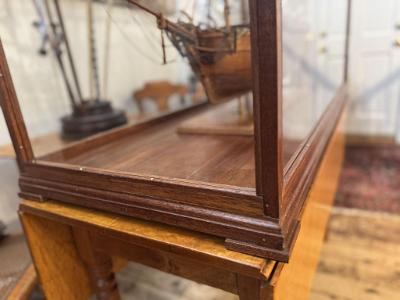
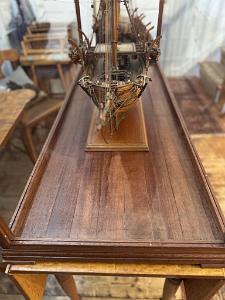
Condition: The model has been very well preserved and is in excellent condition with all its original rigging. The original American flag has been replaced due to the deterioration of the cloth over the years. The model retains its original mahogany case that matches the color of the model and was built by Peter Ness. The case has a wide planked base.
Dimensions of Model: Height 26, Length 31 ½, Width 8 ¼, Inches
Dimensions of the Case: Height 49 1/2, Length 49 1/2, Width 20 3/8
Notes: Peter Henrick Ness (1890-1976) A master craftsman who immigrated to the United States from Norway in 1912. Peter Ness was famous for building ship models from scratch. His rich seafaring family history helped to create a ship’s blueprint in his mind’s eye. From this blueprint Ness was able to apply accuracy to the replicas of ships he built with the use of sight and memory gained from his experience in the European trade. Ness is the endeared dean of ship model making. He fabricated his models in a manner that is reminiscent of exactly how these ships were built. evident in the end result as well as a “Ness made the models as if they were mini ships. They were heavier and bulkier. If you look at the spars, for instance, they are thick and they taper less at the ends. He represented a ship and its hardware better than anyone”. Ness, hand forged his own brass fittings such as the anchors, bells and wheels. He also properly used chain instead of cutting corners with string where a chain, perhaps connected to the anchor for example, might be displayed on a ship. Where the lines are rigged through the dead eyes of the model, Ness properly “served the cords” by wrapping the cords around the ratlines rather than the use of glue and other methods of securing the thread.
Ness specialized in ships built by Boston shipbuilder Donald McKay (1810-1880). McKay built the clipper Sovereign of the Seas which, in 1854, posted the fastest speed ever by a sailing ship - 22 knots. Many of Ness's models are in fixed exhibits inside the Smithsonian, Boston's Museum of Science and a whaler he built was displayed in the White House during the Roosevelt administration. (SM0727)
Dimensions of Model: Height 26, Length 31 1/2, Width 8 1/4
Condition: The model and case are in excellent condition.
The Morgan was launched on July 21, 1841, from the yard of Jethro and Zachariah Hillman in New Bedford, Massachusetts. It typically sailed with a crew of about 35, representing sailors from around the world. The whaleship measures 106 feet, 11 inches length on deck with a beam measuring 27 feet, 9 inches. Its main truck on the mainmast is 110 feet above the deck; fully-rigged, and the ship carries 7,134 square feet of sail. The huge try-pots used for converting blubber into whale oil are on deck; below are the cramped quarters in which the officers and men lived.
Notes: The Morgan was launched on July 21, 1841, from the yard of Jethro and Zachariah Hillman in New Bedford, Massachusetts. It typically sailed with a crew of about 35, representing sailors from around the world. The whaleship measures 106 feet, 11 inches length on deck with a beam measuring 27 feet, 9 inches. Its main truck on the mainmast is 110 feet above the deck; fully-rigged, and the ship carries 7,134 square feet of sail. The huge try-pots used for converting blubber into whale oil are on deck; below are the cramped quarters in which the officers and men lived.
Black and White Photo of the Charles W. Morgan - The Last Wooden Whaleship in the World
Over an 80-year whaling career, the Morgan embarked on 37 voyages with most lasting three years or more. Built for durability, not speed, it roamed every corner of the globe in pursuit of whales. The Morgan is known as a “lucky ship,” having successfully navigated crushing Arctic ice, countless storms, Cape Horn rounding’s and, after finishing its whaling career, even the Hurricane of 1938.
After its whaling days ended in 1921, the Morgan was preserved by Whaling Enshrined, Inc. and exhibited at Edward H.R. Green’s estate at Round Hill in South Dartmouth, Massachusetts, until 1941. In November of that year, the Morgan came to Mystic Seaport Museum where it has since dominated the waterfront at Chubb’s Wharf.
Group of People on the Charles W. Morgan - The Last Wooden Whaleship in the World! The whaleship was designated a National Historic Landmark by order of the Secretary of the Interior in 1966, and is also a recipient of the coveted World Ship Trust Award. Since its arrival at Mystic Seaport Museum, more than 20 million visitors have walked its deck. Where once it hunted and processed whales for profit, its purpose now is to tell an important part of our nation’s maritime heritage and the lessons that history has for current generations.
RESTORATION, PRESERVATION AND THE 38TH VOYAGE
The Charles W. Morgan at Mystic Seaport Museum
At Mystic Seaport Museum, the Charles W. Morgan has been given a new lease on life; however, its future vitality depends on continual preservation. A major program of restoration and preservation was begun in 1968 to repair it structurally, and during the course of this work, it was decided to restore the ship to the rig of a double-topsail bark, which it carried from 1867 through the end of its whaling career. The ship appears as it was during most of its active career.
In January 1974, after removal from a sand and mud berth, the ship was hauled out on the lift dock in the Henry B. duPont Preservation Shipyard for inspection and hull work as needed. The hull proved to be in remarkably good condition, with only a new false keel, worm shoe and some planking being required.
In November 2008, the Morgan returned to the Museum’s shipyard for another restoration. The project renewed areas of the vessel from the waterline down to the keel and also addressed issues in the bow and stern. The whaleship was re-launched July 21, 2013 and left Mystic Seaport Museum May 17, 2014, to embark on a 38th Voyage to historic ports of New England. The nearly three-month journey raised awareness of America’s maritime heritage and called attention to issues of ocean sustainability and conservation. The ship returned from its voyage August 6, 2014, and resumed its role as an exhibit and the flagship of the Museum.
Over an 80-year whaling career, the Morgan embarked on 37 voyages with most lasting three years or more. Built for durability, not speed, it roamed every corner of the globe in pursuit of whales. The Morgan is known as a “lucky ship,” having successfully navigated crushing Arctic ice, countless storms, Cape Horn roundings and, after finishing its whaling career, even the Hurricane of 1938.
After its whaling days ended in 1921, the Morgan was preserved by Whaling Enshrined, Inc. and exhibited at Edward H.R. Green’s estate at Round Hill in South Dartmouth, Massachusetts, until 1941. In November of that year, the Morgan came to Mystic Seaport Museum where it has since dominated the waterfront at Chubb’s Wharf.
Group of People on the Charles W. Morgan - The Last Wooden Whaleship in the World!The whaleship was designated a National Historic Landmark by order of the Secretary of the Interior in 1966, and is also a recipient of the coveted World Ship Trust Award. Since its arrival at Mystic Seaport Museum, more than 20 million visitors have walked its deck. Where once it hunted and processed whales for profit, its purpose now is to tell an important part of our nation’s maritime heritage and the lessons that history has for current generations.
circa 1950
Classification(s)