Woolwork Picture of the "Great Ocean Race of 1866"
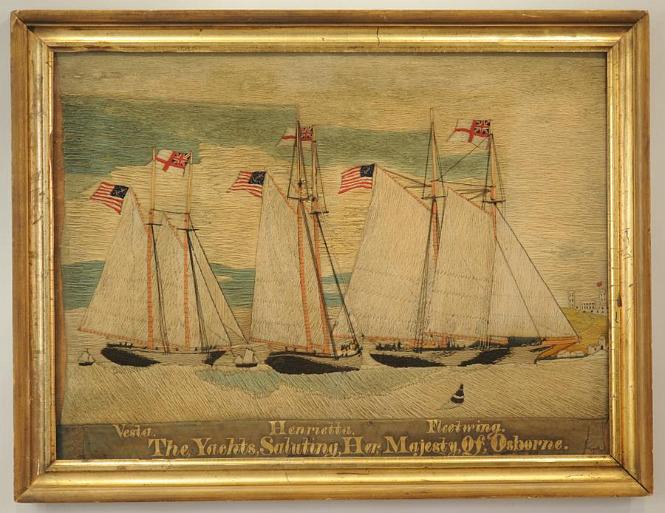
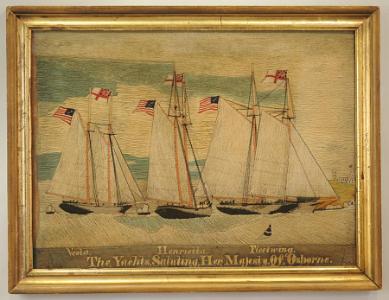
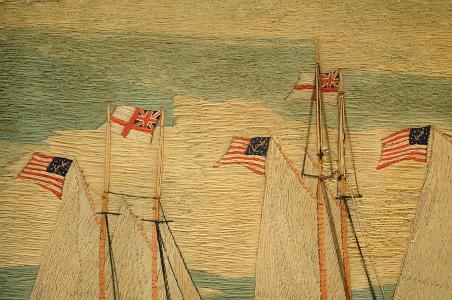
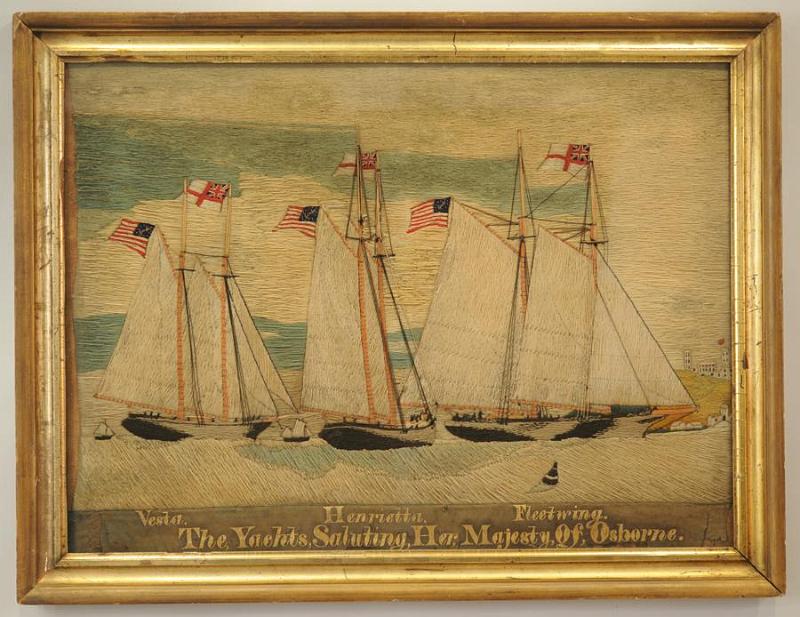
InformationExceptionally rare and important woolwork, depicting the finish of the Great Ocean Race, unknown British artist, 1866. The woolwork is captioned along the bottom margin in gold leaf lettering under each of the three yachts depicted: "Vesta." , "Henrietta.", "Fleetwing." Below the yachts' names the following is written in gold: "The, Yachts, Saluting, Her, Majesty, Of, Osborne." The image depicts on the left a starboard angle view of the Vesta under sail. In the center the winning Henrietta is showing her transom and starboard side and to the right is a starboard view of the Fleetwing. All of the yachts are shown in excellent detail. The spars, rigging and even the crew are clearly delinated. The hulls are shown with black and gray shadowing. Each of the three yachts is flying an American yacht ensign off the gaff and the Royal Navy flag from the main topmast. There are a few small sailboats between the yachts. To the right, one sees a hill with Osborne Castle at its peak. At the base of the hill are a few buildings which probably represent the club house of the Royal Yacht Squadron. The sky and water have a beautiful abstract pattern of light blue, gray and white. This is the only woolie we have examined that depicts an American yacht race. The yacht race depicted is the Great Ocean Race of 1866 which is amongst the greatest Transatlantic Ocean Races of all times. (FA-767)
Reference: Harding, Deborah, "Stars and Stripes Patriotic Motifs in American Folk Art", New York: Rizzoli, 2002, pp. 160-161. This woolwork is shown in full color on this double page spread. Page 160 has a close up detail showing the boats and flags. Page 161 shows the entire woolie and its frame.
Note: On the back of the frame is a printed text giving a brief account of the race. The race began in New York Harbor December 11, 1866 and was won by the yacht Henrietta belonging to the Commodore of the New York Yacht Club, James Gordon Bennett, Jr. Each of the three owners agreed to make a stake of $20,000 each. The race has become one of the most celebrated in yachting history.
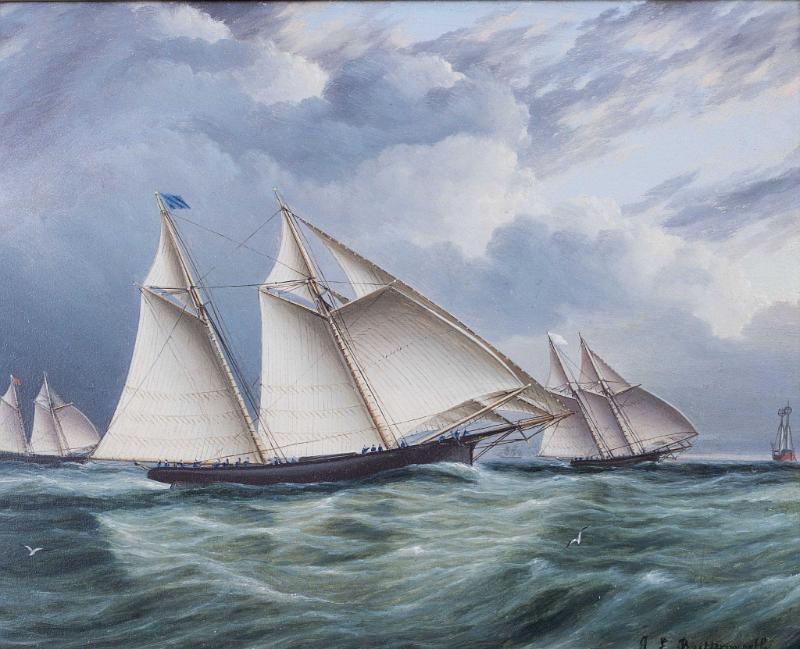
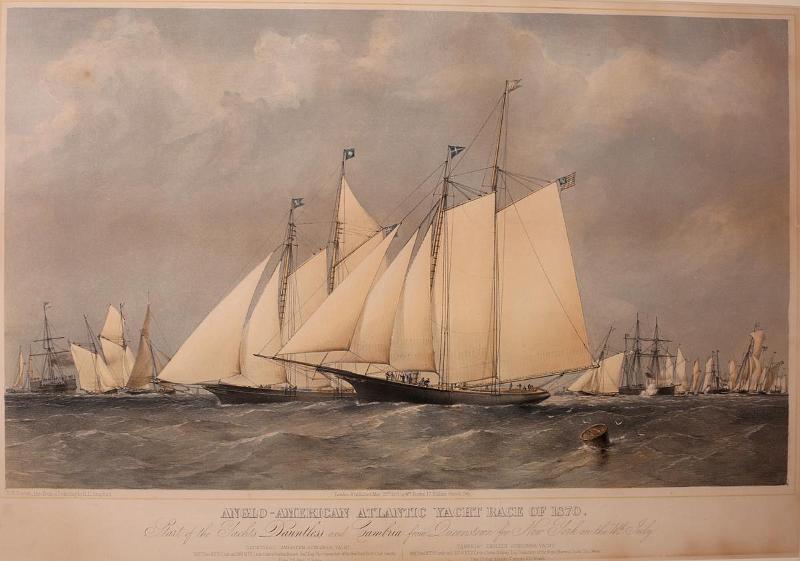
Historical Background: One of the most important and well known of all yacht races is referred to as the Great Ocean Race of 1866. The idea for the race was generated when Pierre Lorillard and George Osgood became boastful about how fast and seaworthy their boats were, after several cocktails at the Union Club, one of New York City’s most famous and oldest clubs. The men then agreed to compete in a race from New York Harbor to Cowes, England home of the Royal Yacht Squadron and where Osbourne Castle the summer home of the Queen is located. These gentlemen agreed to wager $30,000. each. Shortly after James Gordon Bennett Jr. at the age of 25, the oldest of the three participants, agreed to enter the bet making it a three-boat race and spreading the cost to $20,000 each and a purse of $60,000. Each of the schooner yachts flew from the top of their mast different colored flags for identification purposes. Henrietta flew a blue flag and was owned by James Gordon Bennett Jr. whose father owned the New York Herald the largest newspaper in America. Henrietta was built by Henry Steers in Greenport, Long Island. Henrietta was lengthened 15 feet in 1865 by Bennett before the race. She was 205 tons and won first place arriving on Christmas evening in 13 days and 22 hours. Fleetwing flew a red flag and belonged to George Osgood who made his fortune as a financier. Fleetwing was 212 tons and her race time was 14 days 6 hours finishing in second place. Vesta 201 tons flew a white flag and was owed by Pierre Lorillard whose family built a fortune in the tobacco business. Vesta came in last finishing only an hour after Fleetwing. The only owner who actually sailed his boat in the race was Bennett while the others traveled to England by steamship. Just following the start, the yachts passed the Sandy Hook Light Ship off the coast of New Jersey on December 11, 1866 and arrived in England off the Needles on the lsle of Wight at 5:45 PM, December 25th. The yachtsman experienced some foul weather during the journey causing huge problems and delays for all the boats in a storm on December 19. While experiencing gale force winds, Fleetwing was stuck by a huge wave sweeping six men into the sea never to be recovered. The race had captured international attention and James Gordon Bennett was the recipient of the $60,000 purse. The yachtsman and their officers were invited to attend a banquet at the Royal Yacht Squadron and in attendance was Queen Victoria and Price Albert, who were the same members of the Royal Family that were present fifteen years before when they witnessed Yacht America beating the English fleet and taking home what became known as the America’s Cup. The Great Ocean Race was the subject of many news articles on both sides of the Atlantic. The race was also the subject for many artists including James E Buttersworth who painted many versions of the beginning of the race with the yachts passing Sandy Hook and a few of paintings showing the yachts underway crossing the Atlantic while a few other paintings depicting individual participants sailing off of Cowes. The race was also a popular subject for printmakers whose prints were published and widely distributed by various printmakers including Currier and Ives. There were several large and small folio sized prints that were created illustrating the yachts and the race. The only other image we have located showing all three yachts together having completed the race is a Currier and Ives print titled “The American Yachts Saluting her Majesty, Queen Victoria off Osborne House, Isle of Wight. This print was published in the “Illustrated London News” on Jan. 14th 1867. The only other image of this subject is well known wool work picture of the period with the title in gold along the bottom border stating “The Yachts Saluting, Her Majesty of. Osborne.”
Reference 1: Harding, Deborah, "Stars and Stripes Patriotic Motifs in American Folk Art", New York: Rizzoli, 2002, pp. 160-161. This wool work is shown in full color on this double page spread. Page 160 has a close-up detail showing the boats and flags. Page 161 shows the entire woolie and its frame.
Reference 2: Parkinson, John Jr., "The History of The New York Yacht Club", Volume One, 1975. (p.44) "In 1861 there were twenty-five schooners and twenty-seven sloops in the Club Squadron, but it appears that only two of them served in the Union Navy. However, one of these, the schooner HENRIETTA, looms large in subsequent Club history. Designed by Henry Steers, nephew of the late George Steers, the HENRIETTA was originally 92 feet overall, 158 tons. and was built for James Gordon Bennett, Jr. She was a keel boat, and the numerous pictures of her in the Club House together with her model indicate she was a fine clipper-bowed vessel. Her owner was not yet twenty-one years of age and apparently his father, James Gordon Bennett, Sr., who had founded the NEW YORK HERALD and acquired great wealth, presented him with both REBECCA and HENRIETTA." (p.55) "HENRIETTA James Gordon Bennett, Jr. - 225 tons, keel, 107' overall, 22' beam, 11' 6" draft, 13 days, 21 hours, 55 minutes. Best day's run 280 miles." The information provided in these references (pp. 44 and 55) confirms the information on the backboard regarding the lengthening of HENRIETTA by 15 feet.
Reference 3: Harrington, Melissa H., "The New York Yacht Club: 1844-1994", Lyme, Connecticut: Greenwich Publishing Group, Inc., 1994, pp. 28-29. "The Great Transatlantic Race of 1866" "... The casual predinner boasts became serious challenges; finally the Pierre Lorillard and George Osgood committed their yachts to a December match race and then James Gordin Benenett joined in to the race from Sandy Hook to the Isle of Wight. Each man wagered $ 20,000 - winner take all." "The race was won on Christmas Day by HENRIETTA. The log shows her run of 3,105 nautical miles took 13 days, 21 hours and 55 minutes. Bennett would be the only man in history of the Club to serve twice as Commodore ..." .
Circa 1866