The America Ship "CONTINENT" by Duncan Mc Farlane
Information McFarlane, Duncan Attr.
(English 1818-1865)
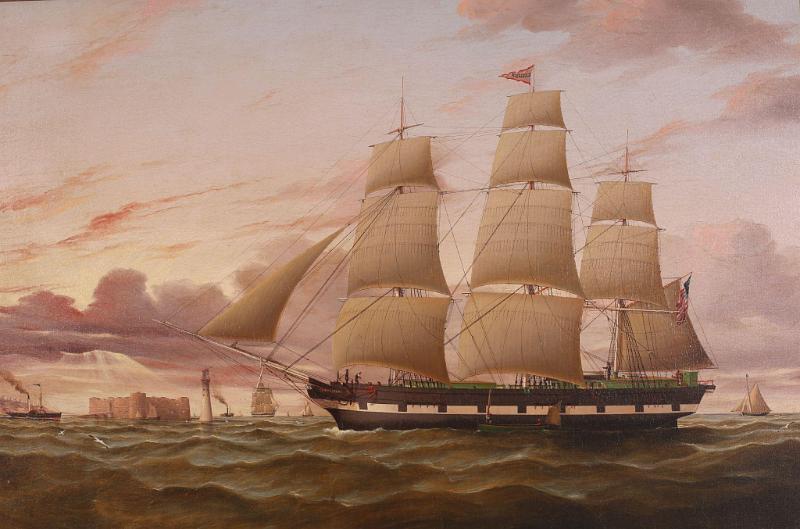
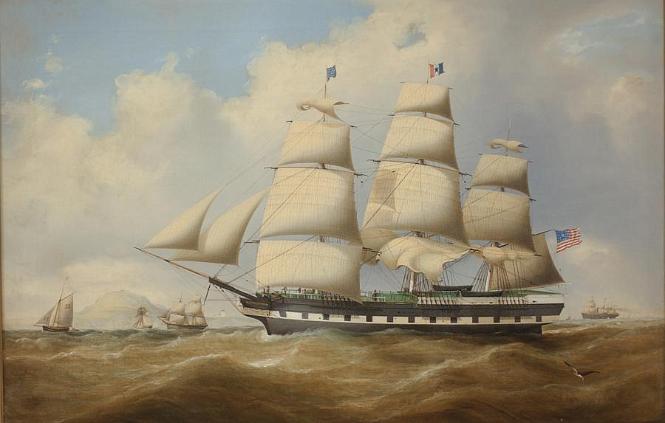
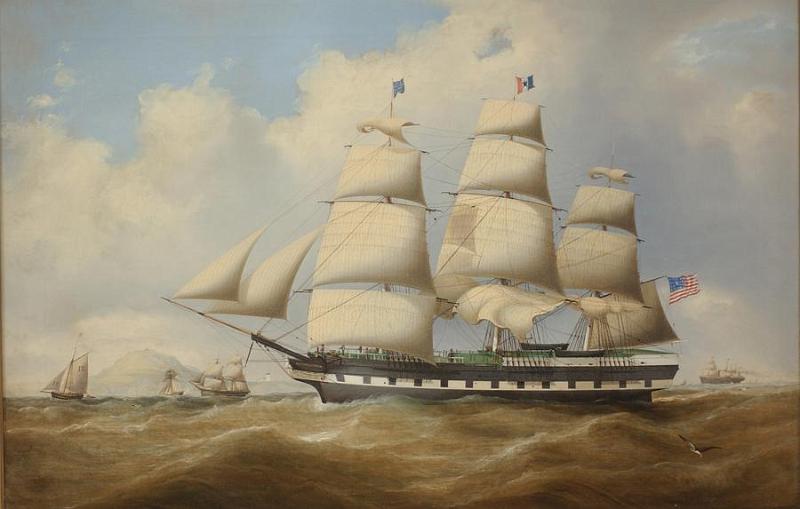
Oil on canvas, depicting the American ship 'CONTINENT' and other vessels coming into Liverpool, circa 1855. The painting has outstanding detail and color and is a fine example of McFarlane's work. The black hull ship has painted false gunports along her side. At the bow, there is a detailed figurehead. Rear of the figurehead is a quarterboard with gold lettering with the name, 'CONTINENT'. Below the quarterboard is a gold painted scrolled trailboard. The ship is flying most of her sails. The lowest sail on the main mast is fluttering while being raised and the lower sail on the aft mast is furled, thus exposing the outstanding detail in the ratlines and standing rigging. The sails are beautifully shaded and retain the original seams and reef points. The shadow in the sails as well as the raised sails are typical McFarlane techniques. Flying from the top of the foremast is the Union Jack and flying from the top of the main mast is a red, white and blue house flag and flying off the gaff is a wonderful depiction of the American flag with a large five pointed star at the center of the blue ground surrounded by seventeen additional smaller stars. To the left of the ship is Point Lynas with a lighthouse signaling the entrance to Liverpool Harbor. There are three sailing vessels including pilot boat No.12, a topsail sloop and a brig. All three vessels are painted in remarkable detail. To the right of the 'CONTINENT' is what appears to be one of the American Collins Line paddlewheel steam sail vessels flying the American flag while navigating under steam and sail. In the right corner is a large hovering gull which has become a hallmark of McFarlane's paintings. (PA-644)
Condition of painting: Please see document folder for full condition report by Yost Restoration. Condition of frame: The painting has a nineteenth century style compo frame with a 23 karat gold surface.
Note: the vessel pictured is the Excelsior of 444 tons built in Kennebunk, ME for Daniel Lord.
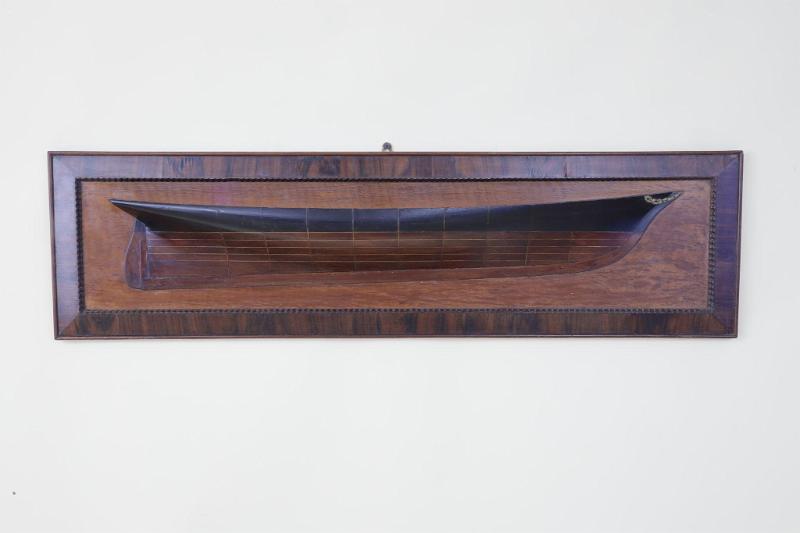
Old newspaper accounts piece together sailing patterns, and I found that the 444 ton Excelsior did also sail to and from Liverpool in the years 1846, 1847, 1850 and 1851. Passenger numbers varied, but at 150 to 190 passengers, is indicative of a smaller vessel than the 999 ton Excelsior, which records as many as 566 passengers on one voyage. Additionally, she is listed as being a two decker, and the scroll billethead is identical to a existent half hull model of the 444 ton ship.
In 1856 the Excelsior rescued the crew of the ship Tejuca, who foundered in a hurricane on her maiden voyage. The Excelsior itself was wrecked off South Carolina in 1859, and PEM has the log of that final voyage from New Orleans. The Brick Store Museum in Kennebunk has the Excelsior's name pennant.
Reference: Peabody Essex Museum, 'Across the Western Ocean: American Ships by Liverpool Artists', Salem, Massachusetts, Vol. 131, 1995. There are several examples of McFarlane paintings illustrated in this collection of Liverpool artists.
Dimensions of painting: 24 x 36.
Dimensions of frame: 33 x 45 1/8.
Circa 1855