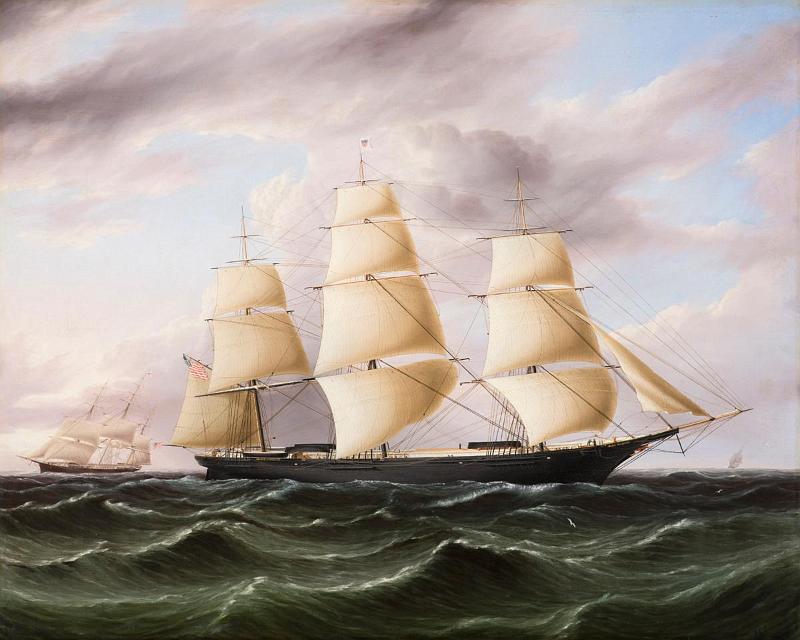
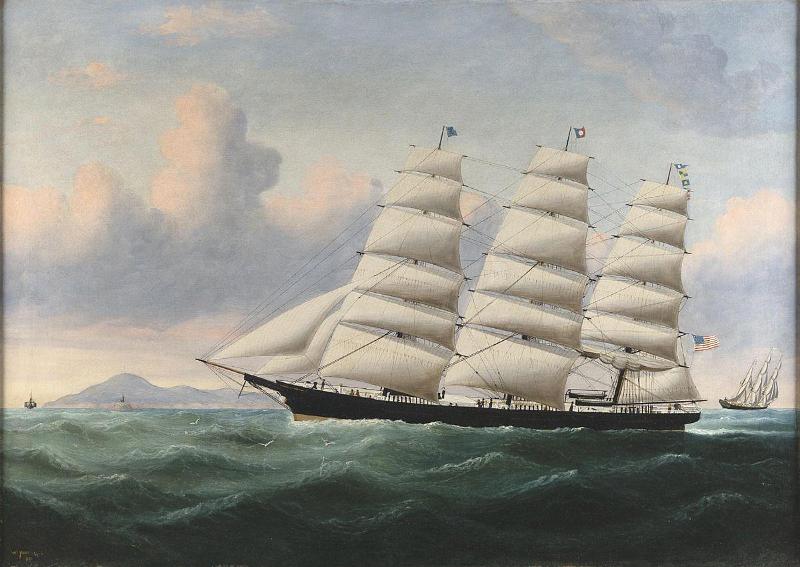
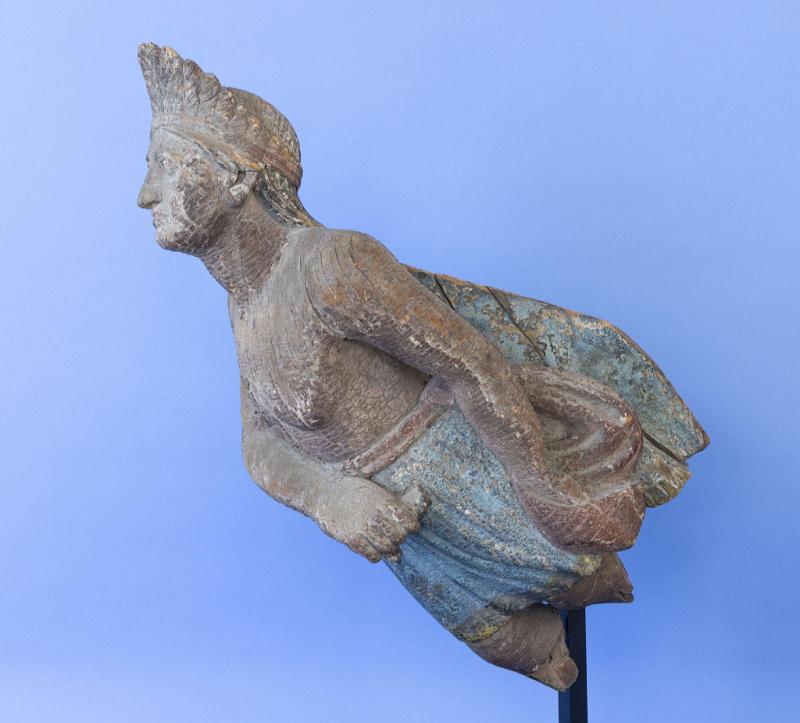
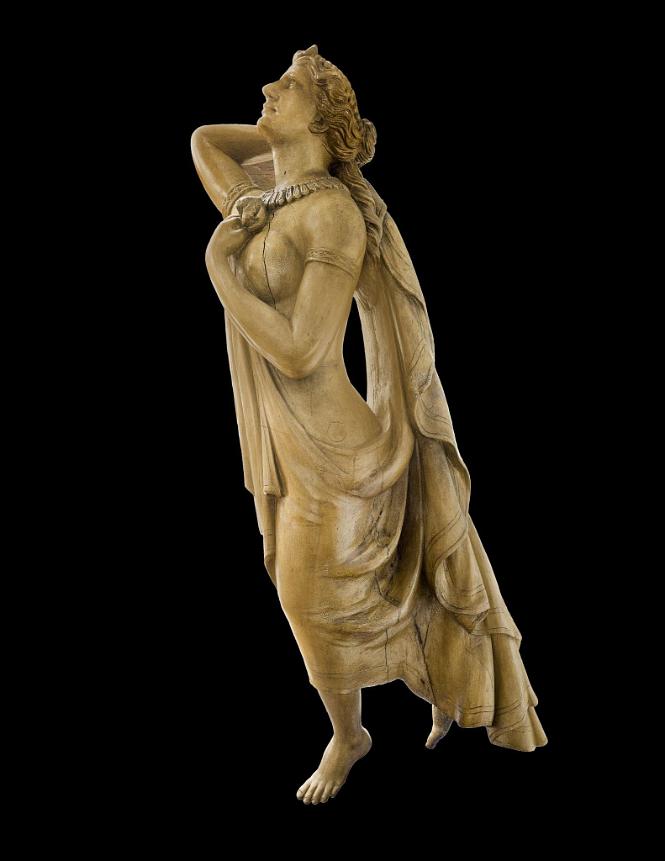
Figurehead from Clipper Ship "Glory of the Seas" carved by Herbert Gleason in Boston 1869
Information
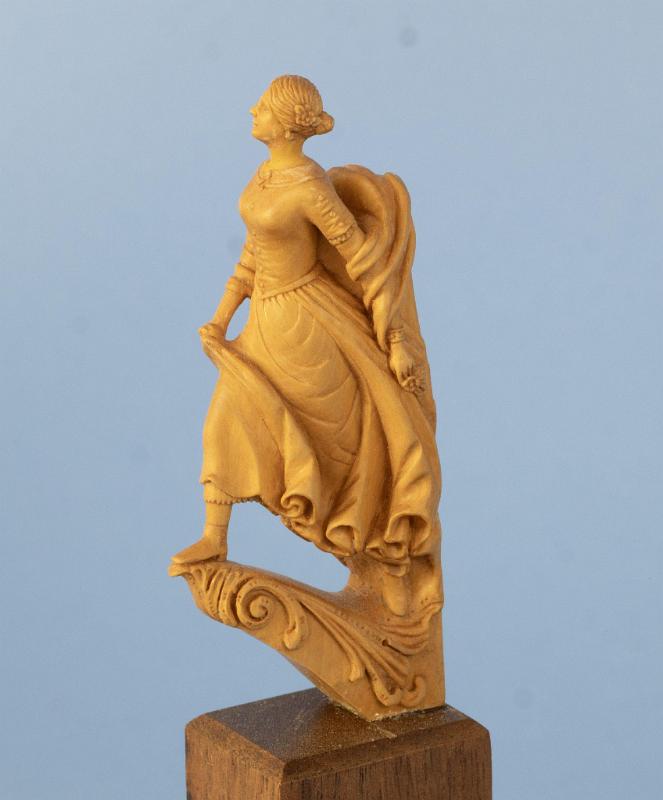
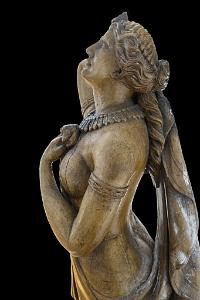
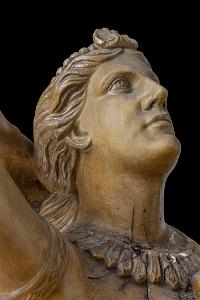
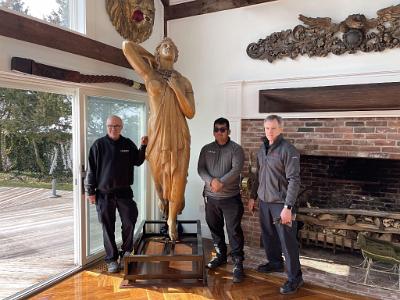
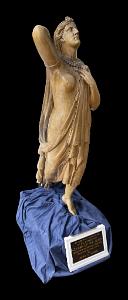
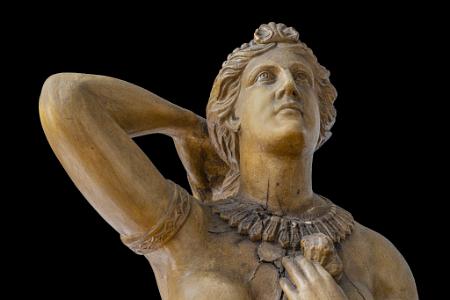
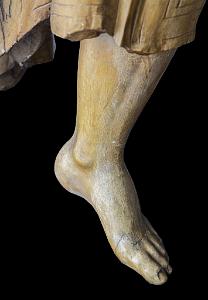
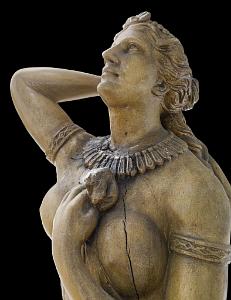
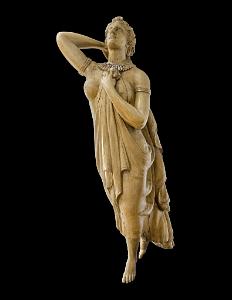
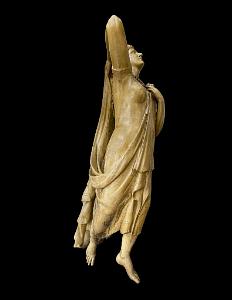
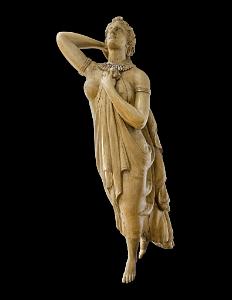
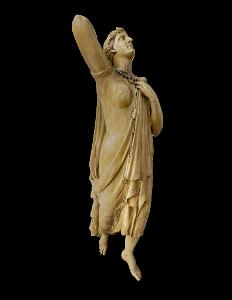
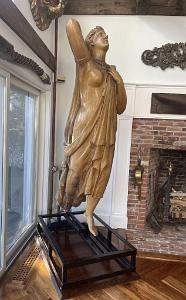
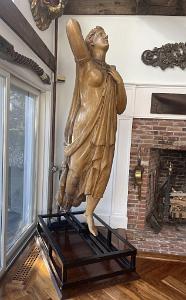
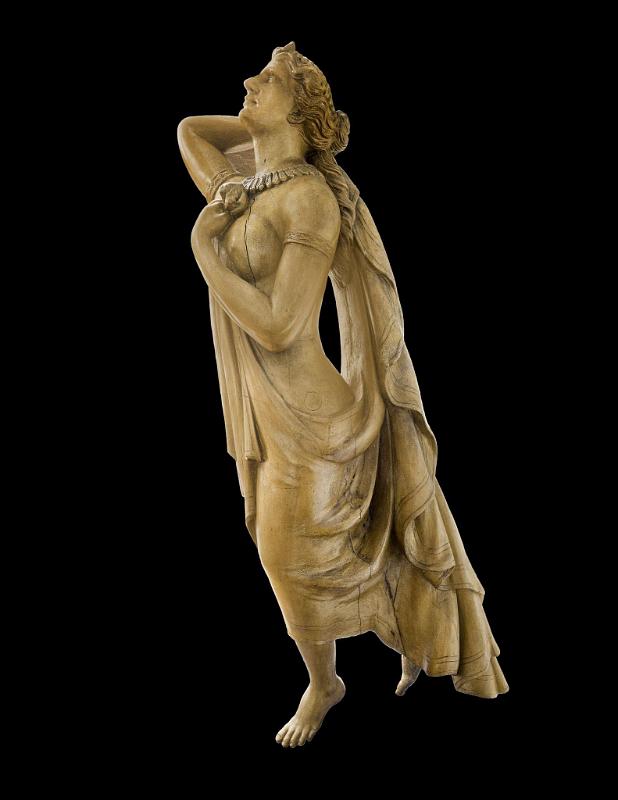
Carved and painted figurehead from the Donald McKay Clipper Ship "Glory of the Seas" in the form of a classical goddess carved by Herbert Gleason in Boston in 1869. Gleason is best known for his figurehead for Donald McKay’s “Glory of the Seas”. “Carved in 1869 she stands on her toes, clutching, loosely flowing drapery between her breasts. Generally Classical in Conception, she wears a necklace and armbands that also reference American Indian adornment. The work is well done and the figure is convincingly articulated. What is particularly striking though, is the extent of her nudity. Her bare feet, ankles and arms, combined with her exposed breasts are extremely rare for an American Figurehead. At the time public opinion was finally coming to accept nudity in the private realm of the fine art gallery or collector’s home." (Reference 4: Text by Ralph Sessions)
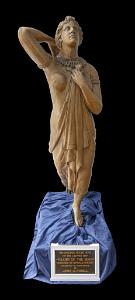
Provenance: Prior to the destruction of the of "Glory of the Seas" in 1923 the figurehead was removed and saved. It was acquired by James A Farrell a major collector and President of US Steel. He was one of the founders of India House to whom he eventually gave the figurehead. The wood plaque with gold painted lettering was exhibited below the figure. James Farrell in 1927 wrote the foreword to the Book "Some Famous Sailing Ships And Their Builder Donald McKay" by Richard C. McKay who in the preface (P. vii) wrote "Mr. Farrell has always been interested in Donald McKay and his ships, especially the "Glory of the Seas", which his father Captain G. Farrell commanded and with whom in his youth, he sailed around the Horn. Almost 100 years later the figurehead was removed from India House with the plaque in 2021 and was sold privately.
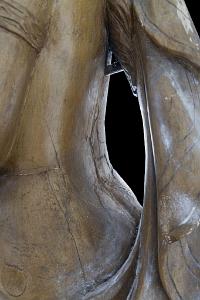
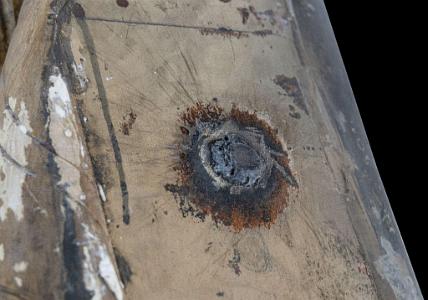
Condition: The figurehead is in excellent original condition. The painted surface going back to when she was mounted at India House. The brownish natural wood color has a crackled surface. There are a few age cracks and the right foot has been repaired.
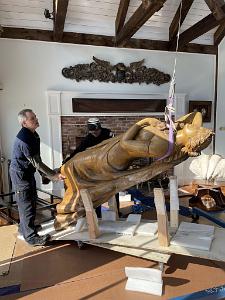
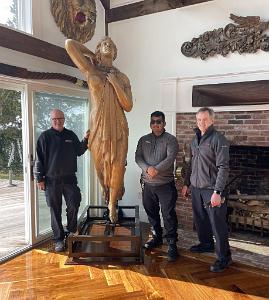
Height: Approximately 8 6" feet: Weight: Approximately 460 pounds
THE VOYAGES OF GLORY OF THE SEAS 1870 - 1885 (Wikipedia)
On her maiden voyage, Glory of the Seas sailed from New York in February 1870 under the command of Captain John Giet. She anchored at San Francisco on June 13 after a passage of 120 days. From there she sailed to Liverpool, England, under Captain William Chatfield. McKay then sold Glory to J. Henry Sears of Boston, who replaced Captain Chatfield with Josiah Nickerson Knowles.
Details of her time between 1870 and 1885 are incomplete, but she "ran between New York and British ports and San Francisco almost exclusively" during those years. She did make a fast voyage from New York to San Francisco between October 13, 1873 and mid-January, 1874. In 1875 she set the record of 35 days for a passage from San Francisco to Sydney, Australia. According to McKay, until 1885 under Captain McLaughlin “Glory” carried general cargo from New York to San Francisco and wheat from there to Britain, and was nearly wrecked in a storm when arriving in Britain in 1880. The Bruzelius timetable differs and does not mention the 1880 event. Both agree that she was laid up at San Francisco between December 1882 and February 1885.
The Peabody Essex Museum has a photograph by W.H. Black of thy launching of "Glory of the Seas" in East Boston. McKay appears at the center of the photograph wearing a top hat.
After 1885, “Glory of the Seas” spent the rest of her long life on the Pacific coast, for a time sailing between San Francisco and Puget Sound and occasionally to Alaska. In March 1906 she was sold in San Francisco for conversion to a barge but was repaired after the April earthquake and "put under sail again".
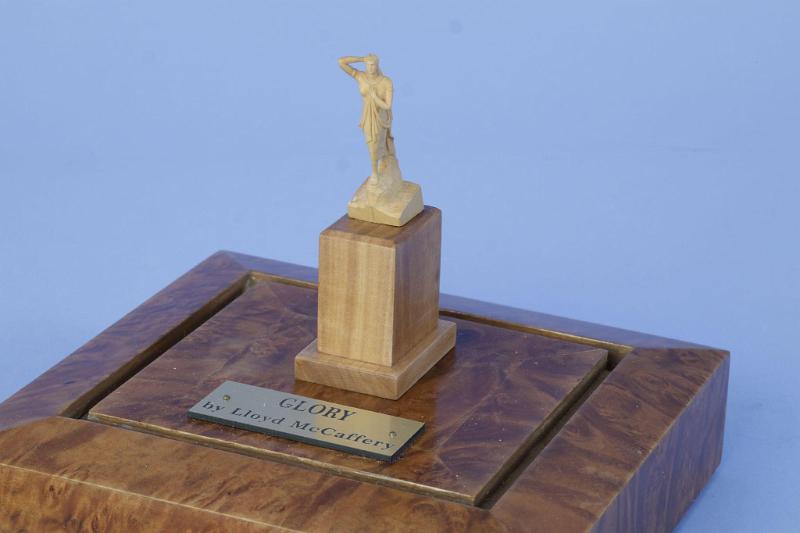
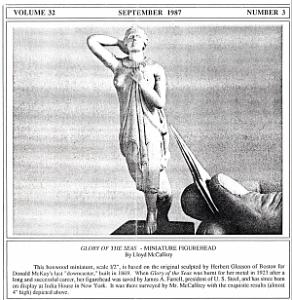
Note: Lloyd McCaffrey a world renowned miniature ship model builder for years had a side interest in creating sub miniature carved figureheads of historic vessels. He stated in the description he wrote regarding his miniature carving of the “Glory of the Seas” figurehead that the “Glory of the seas was at the pinnacle of American ship’s figureheads. He also mention that Michael Jay Mjelde an authority on the “Glory of the Seas” and author of three books about the vessel stated the resulting from the severe exposure to the waves and salt air the ship endured in her many around the world voyages it was necessary to replace her raised right arm which extended off the main body of the figure resulting in greater exposure and damage then the rest of the figure.
Period Account of Glory from her last years.:
In 1911 she was stationed at Ketchikan during the summer months and became the feature in an article published in the periodical Outlook. A writer/photographer visited Glory and in doing so not only photographed the figurehead but wrote a text in which he wrote his personal impressions which is one of the best that I have seen in which the writer viewed the actual figurehead mounted on the ship following which he wrote his text. It read as follows:
“The Glory of the Seas at the wharf at Ketchikan, her topgallant masts down, her jib-boom gone, and only one stick left of the crowding yards that had once carried her clouds of canvas.
“’Going to take a picture of the lady?’” someone asked, as I set up the tripod.
“Under the stubby bowsprit…was poised one of the finest figureheads I have ever seen. He must have been something of an artist who carved ‘the lady,’ for her face was comely and strong and good, and there was dignity in her air, in spite of the evil days she had fallen on…there floated under her aristocratic nose a stream of fish refuse that came from the Glory’s own scuppers…"
Michael Jay Mjelde
Height: 8 feet
Weight 460 pounds approximately
During my research, I came across an old newspaper article describing the transformation of the clipper Glory of the Seas into a salmon cannery. In this article, an old sailor named a fetching woman of unusual beauty, Elizabeth le Forgue of East Boston, as the model for Athena. Apparently, she was betrothed to a sailor named John Martin who sailed aboard the Glory in ’69 and was to marry her upon his return. He delayed and there was speculation whether it was deliberate or accidental. Unfortunately, the young lady drowned off one of her father’s fishing boats. The night her body was recovered, moonlight revealed she had but one arm. The old sailor said that the very day she drowned, seas were running high on the clipper ship. When calm returned, the figurehead was also missing her right arm! John Martin was considered odd by the rest of the crew, since ever after he was constantly beautifying the figurehead. Eventually, in the ’80’s, he too was lost overboard in a storm. Ever since then, Glory’s figurehead couldn’t keep her right arm…. Even today, if you look at the replacement, her arm is not as elegant as that which originally graced Athena at Glory’s launch.
Part of my conviction that Glory of the Seas was a beautiful ship when she slid down the ways was her quite lovely figurehead. She has been described as the epitome of the ship carvers’ art. As these few images of her confirm, Athena was indeed a strikingly impressive combination of serene confidence and self-assuredness. It’s uncanny how lifelike she appears. It is hard to realize that she’s only a wooden carving. The way her flowing drapery is displayed, gracefully trailing behind her outstretched right arm, emphasizes her natural movement. She’s indeed a gorgeous tribute to McKay’s powerful clipper. Recreating her in miniature is an incredible challenge. At 1:96 scale she’s just 7/8" tall and at 1:72 scale, just slightly larger at 1¼" high.
In retrospect, even as I write this, I’m still amazed at how deep our group went for each detail of Glory’s construction. I doubt anyone before us had spent so much time just examining the particulars of her figurehead. For instance, just the positioning of her right hand became a back and forth between me and David Antscherl as he was recreating her missing arm. Having spent quite a lot of time examining her pose, I was able to explain to him that her hand was turned palm down to grasp her drapery, and not up, as David first thought.
During my research, I came across an old newspaper article describing the transformation of the clipper Glory of the Seas into a salmon cannery. In this article, an old sailor named a fetching woman of unusual beauty, Elizabeth le Forgue of East Boston, as the model for Athena. Apparently, she was betrothed to a sailor named John Martin who sailed aboard the Glory in ’69 and was to marry her upon his return. He delayed and there was speculation whether it was deliberate or accidental. Unfortunately, the young lady drowned off one of her father’s fishing boats. The night her body was recovered, moonlight revealed she had but one arm. The old sailor said that the very day she drowned, seas were running high on the clipper ship. When calm returned, the figurehead was also missing her right arm! John Martin was considered odd by the rest of the crew, since ever after he was constantly beautifying the figurehead. Eventually, in the ’80’s, he too was lost overboard in a storm. Ever since then, Glory’s figurehead couldn’t keep her right arm…. Even today, if you look at the replacement, her arm is not as elegant as that which originally graced Athena at Glory’s launch.
1869
Classification(s)